Saturday, November 12, 2011


Monday, November 7, 2011
Trauma Resus: Part I
Source: http://emcrit.org/podcasts/trauma-resus-part-i/
Thought we’d talk about some trauma stuff, specifically the resuscitation of the critically ill hemorrhagic shock patient.
There is much to discuss, so this will be a multi-episode affair.Today, we’ll concentrate on the Lethal Triad and BP Goals.
Lethal Triad
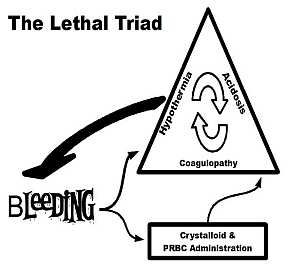
The picture says it all.
Bleeding causes acidosis, hypothermia, and coagulopathy. Then the cycle begins as they all beget each other. If this continues for too long, it is irreversible.
We can iatrogenically make things worse by keeping our patients exposed and infusing ice cold fluids and products. By diluting their existing clotting factors and platelets with too much fluid and red cells. And by not ensuring adeqaute perfusion to counter acidosis.
BP Goals
Your goal is a MAP of 65. This is not hypotensive resus, which is still not proven. It is normotensive resuscitation; beyond 65, no additional benefts will be seen, but you do risk increased bleeding and dilutional coagulopathy.If MAP < 65 – give fluids/products
If MAP > 65 – check perfusion
there are monitors for this such as NIRS measurement of thenar eminence, but at this stage, I recommend using the presence of a nice strong pulse and warm hands.
MAP > 65 & Good Perfusion-stand tight
MAP > 65 & Bad Perfusion-give fentanyl 20-25 mcg
why fentanyl? b/c taking away pain and fear will limit endogenous catecholamines and the pt’s bp will drop slightly from vasodilation. Now give fluids/products to take the MAP to > 65.
Here are the articles
resus of crit ill trauma patients
damage_control_anesthesia Read more...
Sunday, November 6, 2011
Psychogenic Coma
Source:http://emphysicaldiagnosis.com/2011/08/09/psychogenic-coma-and-malingering/ I have now heard several stories of prisoners faking a coma. In one, he was intubated for a GCS of 8, and the first clue was that the television was mysteriously and seemingly autonomously rotated toward the patient. Eventually they lay a trap involving blocking access to the television, and were able to catch him in the act. Patients do of course lie to us, but many patients have psychogenic coma, where they are not intentionally fabricating the coma, which arises from psychological distress and is termed a conversion reaction. How can physical diagnosis demonstrate to us that a patient is actually awake? Apparently the oculocephalic (doll’s eye) responses can give either fixed eyes or reflex responses. However, the cold caloric oculovestibular reflexes are thought to be highly sensitive and specific, though they appear not to have been studied in this population. Irrigate an ear with 60-100mL of ice water. A patient in a true coma with an intact brainstem shows a slow tonic deviation of the eye toward the ice. Patients with damage to the brainstem show no response. A patient who is awake shows fast phase nystagmus away from the cold ear. Plum and Posner write “it is the presence of normal nystagmus in response to caloric testing that firmly indicates that the patient is physiologically awake and that the unresponsive state cannot be caused by structural or metabolic disease of the nervous system.” Later on they do qualify this statement by suggesting that intense visual fixation might overcome this nystagmus in some situations. Other findings that are not consistent with organic disease include resistance to eye opening and rapid/active eye closure once released. Coma findings that cannot be fabricated include the slow smooth closure of opened eyelids and roving eye movements. Apparently the rolling upward of the eyeballs upon lid opening is a voluntary act, though I have not been able to find a citation for that. Dropping the arm on the face is commonly used, and usually helpful, though I have seen it give a misleading result. With a thorough history and examination, the hope is that the diagnosis will become more clear. Take home points: Fast nystagmus away from the ice indicates an awake patient Resistance to eye opening and active eye closure suggests an awake patient References: Plum and Posner The Diagnosis of Stupor and Coma. This is a classic text that is highly recommended.
Read more...Friday, November 4, 2011

Thursday, November 3, 2011
When to wean the CPAP in SCAPE
Source: http://emcrit.org/blogpost/when-to-wean-cpap-scape/
SCAPE= Sympathetic Crashing Acute Pulmonary Edema
Gabe writes:
REMCS notification of an obese female in her 50s being brought in on
CPAP for resp distress, history of CHF, tachypneic and tachycardic.
Immediate page for respiratory to bring down NIV.
When she came through the ambulance bay, I categorized her immediately
(thanks to your podacst): SCAPE. Tachycardic, hypertensive, tachypneic,
diaphoretic, and severely agitated saturating upper 80s with crackles to
her apices. With intubation gear ready, I placed her on a PEEP of 8 and
dropped at SL NTG 0.4mg under her tongue (couldn’t get the IV nitro in
time) and gave 50mcg fentanyl.
2 minutes later: RR 24 (from 40s), sat 100%, HR 80s, dry skin, and
talking to us behind the CPAP. My attending was so proud and, quite
frankly, relieved at not having to intubate an impossible airway.
My question is: once the patient has stabilized on the NIV, do we wean it down? Switch to NRB? Leave it to the CCU?
Thanks!
Gabe, Great question!Here is how I wean the CPAP on these folks:
- The patient must look good–I mean really good before I’ll even think of turning the dial. No diaphoresis, no labored breathing, can talk to you easily under the mask.
- The blood pressure must have dropped to the patient’s norm or what you think is the patient’s norm.
- The nitro drip must have done its precipitous drop thing, by which I mean, at some point these SCAPE patients turn off their sympathetic surge. Their nitro drip necessity will go from a level such as 180 mcg/min to 30 mcg/min. Once that happens, you know you are over the hump.
- When all of the above have occurred, I drop the fiO2 to 40% and then I start weaning down the PEEP setting about 2 cmH20 every 5-10 minutes.
- Check the patient for the above before each subsequent PEEP drop.
- When they are at 5 cmH20, give them a trial of nasal cannula.
- Keep the entire CPAP set-up ready at the bedside
- If the patient’s BP spikes or they get sweaty and are having trouble breathing, put them back on CPAP and go back up on your nitro.
- Now is the time to assess whether you think they are volume overloaded and if you think it is clever, give them a diuretic. For me I’d rather they get their kidneys going with the nitro instead of the diuretic.
Read more...
Tuesday, October 25, 2011
Ventilator settings for acute lung injury and ARDS
Source:http://academiclifeinem.blogspot.com/2011/10/paucis-verbis-ventilator-settings-for.html

Ventilator settings for obstructive lung disease
Source:http://academiclifeinem.blogspot.com/2011/10/paucis-verbis-ventilator-settings-for_21.html

Subscribe to:
Posts (Atom)